Fruit Flies Use "Sweetest Vomit" as Romantic Gift, Rewiring Brain for Courtship
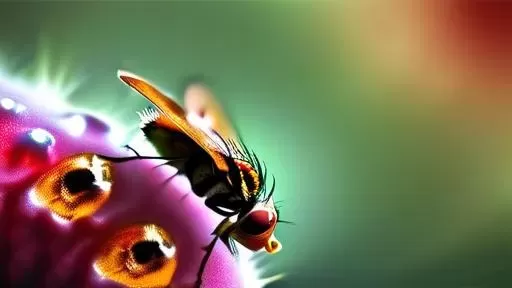
In the world of insect courtship, a droplet of regurgitated food might be the ultimate symbol of affection. For the male Drosophila subobscura fruit fly, this peculiar behavior is a key to winning over a mate, and new research reveals the fascinating neural rewiring that makes this romantic gesture possible.
Scientists have discovered that this unique form of courtship, where a male offers a "nuptial gift" to a female, likely evolved by repurposing brain cells typically dedicated to digestion. This finding provides a remarkable window into how complex new behaviors can emerge through evolutionary innovation.
The Art Of Fly Courtship
While many male fruit flies rely on serenading females with a species-specific wing vibration, D. subobscura males have adopted a more visceral strategy. During their pursuit of a female, they will vomit a small portion of their recent meal and present it to her. This offering, reminiscent of nuptial gifts in other species like spiders, is thought to help a choosy female assess the quality of her suitor.
A Protein's Pivotal Role
The secret to this behavior lies in a protein called fruitless. In fruit flies, the thousands of neurons that govern courtship rituals produce a male-specific variant of this protein. Researchers found that by artificially activating these neurons, they could trigger a male D. subobscura to perform his entire seduction routine, complete with the regurgitation, even in the absence of a female.
The investigation took a significant turn when scientists identified a specific cluster of just 16 to 18 neurons responsible for controlling digestion. In D. subobscura, these gut-controlling neurons surprisingly also produce the male-specific fruitless protein. Activating this small group of cells was enough to induce the vomiting behavior, which in turn made the males significantly more successful at mating.
Evolutionary Repurposing Of A Neural Circuit
To understand how this trait evolved, the research team looked at a different species, Drosophila melanogaster, which diverged from D. subobscura tens of millions of years ago. This common lab fly does not engage in vomit-wooing. Crucially, its digestion neurons do not produce the male-specific fruitless protein and are not connected to its courtship neural network.
The experiment provided the breakthrough. When researchers genetically engineered D. melanogaster males to produce the fruitless protein in their digestion neurons, a remarkable change occurred. These males began regurgitating as they courted females. Furthermore, the neurons themselves grew larger, suggesting they were forming new connections with the existing courtship circuitry in the brain.
This indicates that the romantic barfing behavior evolved by co-opting an entire pre-existing circuit. The neural pathway used for a simple digestive act—vomiting when overstuffed—was borrowed and integrated into the complex suite of courtship behaviors. The researchers propose that this connection may have initially occurred by accident, but it proved to be a highly advantageous evolutionary twist.
This cross-species comparison offers an amazing example of how sex-specific behaviors can come into being. It demonstrates that evolution can create new and complex rituals by reassembling existing neural components, turning a basic bodily function into a powerful tool for romance.